Team
In-house Development
2006 – 2025
Founded in 2006 under the supervision of Prof. Rong Xiong at the College of Control Science and Engineering, Zhejiang University, the team works out of the State Key Laboratory of Industrial Control Technology and the ZJU Robotics Education Practice Base (the laboratory started its robot soccer programme in 2000 and first entered the RoboCup World Cup in 2003). Members come from control, computer science, mechanical, information and biomedical engineering. Everything was built in-house — mechanics, electronics, motor drives, motion control, vision and behaviour planning: 20 degrees of freedom, 58–70 cm tall and about 4 kg, joints evolving from RX-28 / RX-64 to DYNAMIXEL MX-28 / MX-64 / MX-106, on-board computing from an Intel Atom Z530 and Core i5/i7 up to NVIDIA Jetson TX1 / TX2 and Orin NX, and motion control moving from a mature ZMP preview controller towards MPC, with a reinforcement learning framework first set up in 2025.
Key milestones
- 2007 / 2009 / 2010 Won the humanoid KidSize title at the China Robot Competition & RoboCup Open; the 2010 title was defended with a perfect record, 25 goals scored and none conceded.
- 2013 Third place at RoboCup in Eindhoven, the team’s first World Cup podium. The robot of that year was 58 cm / 4 kg / 20 DoF, using RX-28 and RX-64 servos with an Intel Atom Z530.
- 2014 – 2017 Joints switched to the DYNAMIXEL MX series and on-board computers to Intel Core i5/i7; runner-up at RoboCup in both 2016 and 2017, plus the 2017 Iran Open title (4:2 against MRL-HSL in the final).
- 2016 Team website and GitHub organisation went live, with networking and communication modules released publicly.
- 2018 Computing moved to NVIDIA Jetson TX1/TX2 and the camera to an OmniVision OV2710, robots 62–70 cm tall; fourth place at RoboCup (Montréal) and second in the Drop-In competition.
- 2019 Runner-up at RoboCup (Sydney, 0:1 against Rhoban in the final) and at the German Open; released open-source examples for colour segmentation and white-balance calibration.
- 2020 Won the humanoid division of the RoboCup China Open, 7:0 in the final without conceding a single goal — a double title together with ZJUNlict.
- 2023 Back on the international stage: third place at RoboCup Asia-Pacific (Pyeongchang, Korea) and winner of the Tianjin International Invitational.
- 2024 Round of 16 at RoboCup (Eindhoven, the Netherlands).
- 2025 On-board computing upgraded to NVIDIA Jetson Orin NX and some robots fitted with ZED mini stereo cameras; fourth place in KidSize at RoboCup (Salvador, Brazil).
Open-Source Milestone
December 2025
The team decided to open-source its complete match software, so that new humanoid teams at Chinese universities no longer have to build a whole system from scratch — lowering the barrier to entry. It is the first time the twenty-year “our own robots, our own software” stack has been opened up as a whole.

Booster Robotics Stage
2026 – present
From the 2026 season the team competes on the Booster K1: about 95 cm tall, 19.5 kg and 22 degrees of freedom, listed in the HSL 2026 rule book among the platforms for the Middle division (up to 125 cm / 25 kg). Walking, kicking and getting up after a fall are now trained with reinforcement learning, and the tactics were adapted to the new 2026 rules.
Key milestones
- 2026 Switched to Booster K1 as the competition platform; Booster Robotics became a team sponsor.
Advisors
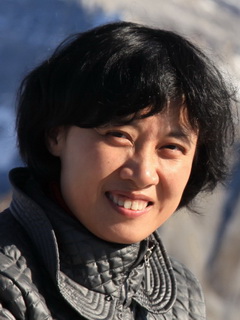
Rong Xiong (熊蓉)
Professor, PhD supervisor
Professor Rong Xiong works at Zhejiang University, where she researches robot perception, learning and control. She is Director of the Robotics Laboratory at the Institute of Cyber-Systems and Control, Co-director of the ZJU-UTS Joint Research Centre on Robotics, a member of the RoboCup International Board, and a member of the expert group on intelligent robots for China’s Ministry of Science and Technology.
She also heads the ZJU Robotics Practice Base for Science Education, supporting robotics training and competition practice. She is a recipient of Zhejiang Province’s “Ten Thousand Talents” Program and a first-tier member of its “New Century 151” Talents Program.

Xingwen Zheng (郑兴文)
Hundred-Talent Program Researcher, PhD supervisor
Xingwen Zheng is a Hundred-Talent Program researcher and PhD supervisor at Zhejiang University, a recipient of the National High-level Young Talents Program, vice chair of the RoboCup China Committee, and an associate editor of IEEE Transactions on Robotics. He received his PhD from Peking University and the University of Groningen, and was a JSPS postdoctoral fellow at the University of Tokyo.
His research focuses on bio-inspired robotics, underwater robotics and bio-inspired sensing, with more than 30 published papers and 20 granted patents.
Team Roster
Decision Making
Class of 2024
- 张天羽
- 杨孜轩
- 丁翔
- 倪振昊
Class of 2025
- 肖子锋
- 王睿恒
- 张天泽
- 上官加城
- 李昱龙
- 阎德淳
- 黄伟杰
Class of 2026
- 张腾
Motion Control
Class of 2024
- 魏英殊
- 李彦霖
- 叶恒青
- 胡博文
Class of 2025
- 王天逸
- 张蕾
- 李翔宇
- 柴浩洋
- 于笑晗
- 胡尊昊
- 张不凡
Vision
Class of 2024
- 周星豪
- 赵楼晗
- 王睿
- 朱曦彤
Class of 2025
- 陈家俊
- 王楚乔
- 王文博
- 白希墨
- 陈铭尚
Class of 2026
- 翟彦棋
Mechanical
Class of 2024
- 金思睿
- 李颖睿
Class of 2025
- 余文杰
- 梁议心
Electronics
Class of 2025
- 苏玥汶